AI-Driven Neural Surrogates for Precision Cognitive Neurostimulation
Marco Rothermel, Madleen Stenger, Soroush Daftarian, Svenja Jule Francke, Bita Shariatpanahi, José C. García Alanis,
Mohammad-Ali Nikouei Mahani, Tim Hahn, and Hamidreza Jamalabadi
Affiliations
[1] Department of Psychiatry and Psychotherapy, University of Marburg, Germany
[2] Center for Mind, Brain, and Behavior (CMBB), University of Marburg, Germany
[3] Institute for Translational Psychiatry, University of Marburg, Germany
[4] Faculty of Medicine, University of British Columbia, Canada
Precise modulation of human cognitive-affective states holds immense clinical potential but requires robust models of
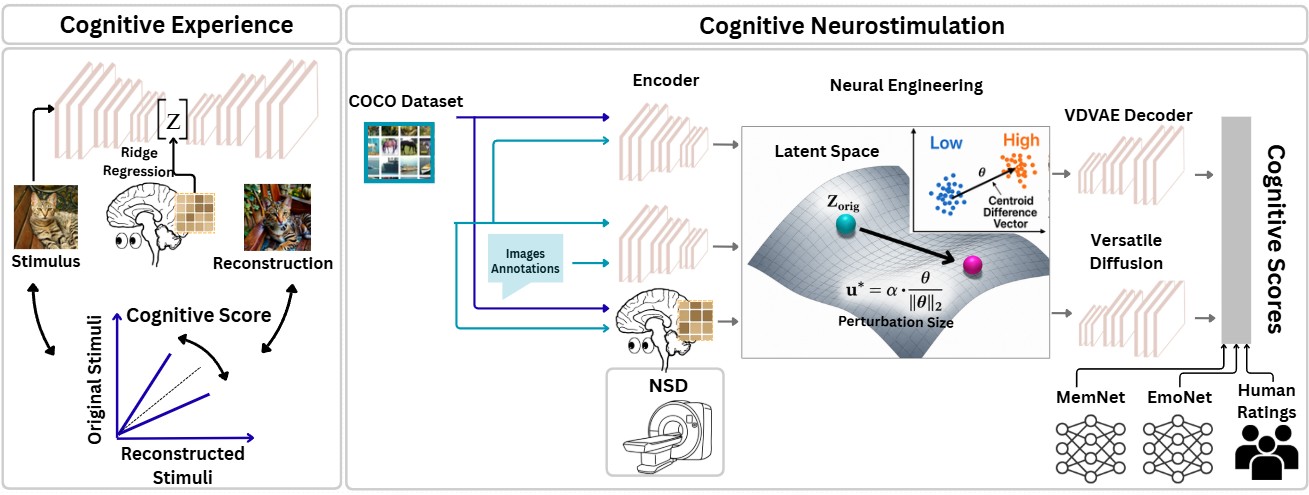
brain-behavior relationships and principled control methods. We introduce a framework that integrates deep generative AI
with a control theoretic formulation to develop an AI-driven neural model of human visual cognition, capable of designing
neurostimulations that modulate key dimensions such as emotional valence and memorability. Our contributions are threefold:
(i) we construct AI models that accurately map early-visual fMRI signals into high-dimensional latent spaces, (ii) we derive
closed-form neural perturbations, and (iii) we validate these perturbations across over 9,000 fMRI-image trials from the
Natural Scenes Dataset and 8,000 independent human ratings. Perturbations are reconstructed into photorealistic images via
a CLIP-guided diffusion model, enabling direct interpretation in stimulus space, and are evaluated using differentiable
assessors (MemNet, EmoNet) and human judgments. Across datasets and rating modalities, AI-designed perturbations achieve
systematic, bounded, and neurally plausible changes in emotional valence and memorability. These results establish
AI-driven models as reliable tools for designing future neurostimulation technologies, offering a path toward clinical
translation.